
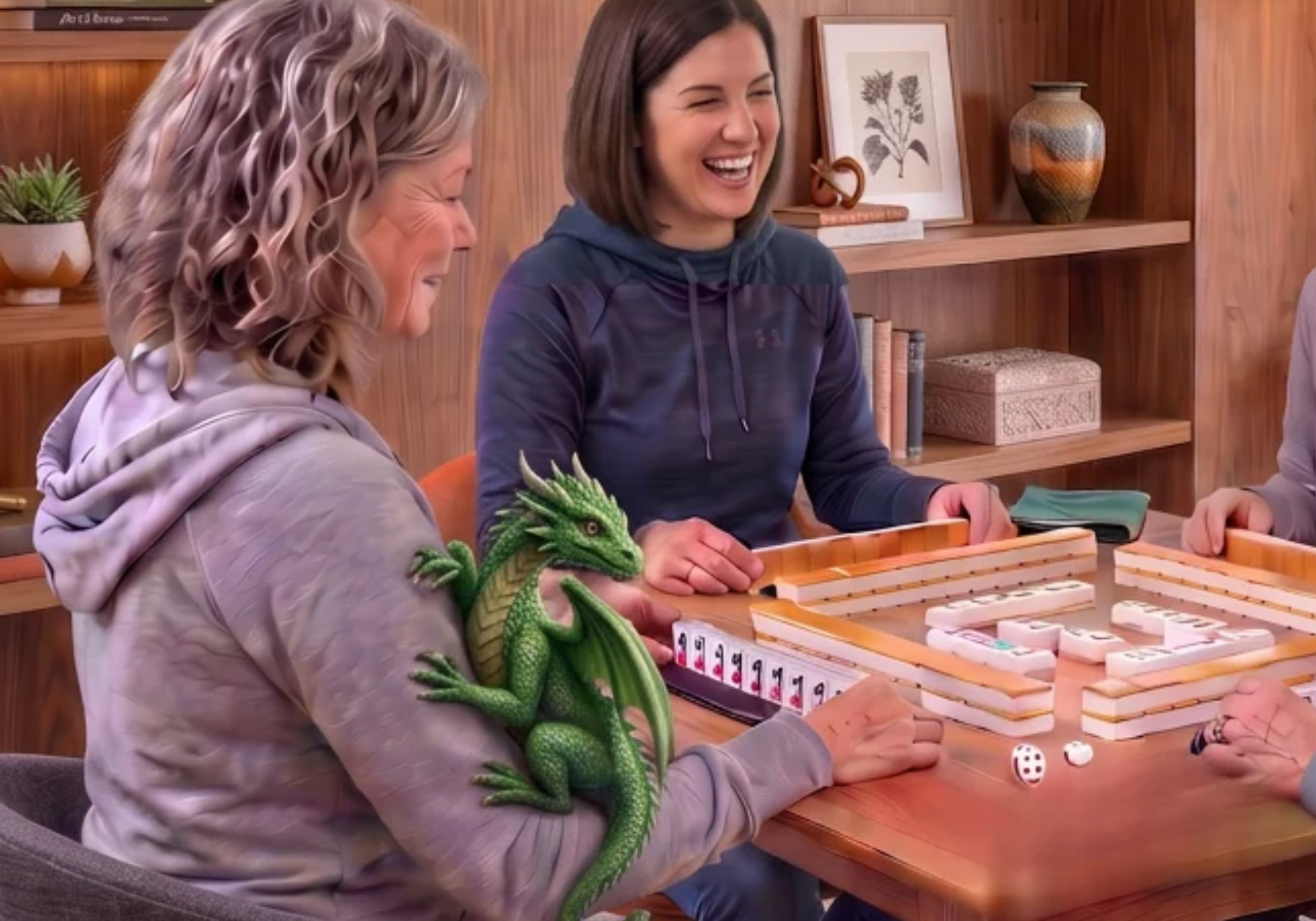
I was playing mahjong last week and found myself tantalizingly close to completing my hand. I needed just two more tiles, one of which was a Green Dragon.
Here's what made things interesting: my hand required one of each dragon. Three singles. That meant I couldn't use a joker to substitute for any of them, and I couldn't call a discarded dragon unless it was the final tile I needed for mahjong.
I had a decision to make. I could abandon the hand and look for something else, or I could take a gamble. If I drew the Green Dragon myself, I was in great shape. Alternatively, if I drew the other tile I needed (which could have been a joker), I'd be able to call a discarded Green Dragon for mahjong.
I knew there were still two Green Dragons in play, so I was cautiously optimistic. I decided to stick with my hand.
And then the player to my right discarded a Green Dragon. Before I could fully recover from that disappointment, the player to their right discarded the fourth and final Green Dragon.
And just like that, my hand was dead.
No amount of optimism, wishful thinking or creative tile rearranging was going to change the fact that the tile I needed was no longer available.
It was time to pivot.
Don't Confuse Impatience With Information
One of the biggest mistakes newer players make is changing hands too quickly. They choose a hand, draw a few tiles that don't help, and immediately start searching the card for something better.
But mahjong requires patience. You're not going to draw a useful tile every turn, and a few disappointing draws don't necessarily mean you've chosen the wrong hand.
The key is learning to distinguish between a hand that's taking longer than you'd like and a hand that's becoming increasingly unlikely, or even impossible, to complete.
In my case, the decision was clear. Both remaining Green Dragons had been discarded, and because I needed a single, a joker couldn't save me. My hand was no longer possible.
Most decisions aren't quite that obvious.
Pay Attention to What's Happening on the Table
The longer you play, the more you'll realize that the tiles on the table are telling you a story.
Let's say you're working toward a hand that requires a pung of 5 Dots. You have one in your rack, and two more have already been discarded. Your chances of completing that pung with natural tiles have narrowed considerably, although jokers may still help.
Or perhaps you're working toward a hand that requires a pair, and three of the four available tiles are already visible on the table. If you don't have either tile in your rack, that pair is no longer possible.
The lesson? Don't get so focused on your own rack that you forget to watch what's happening around you. Every discard and exposure gives you information that can help you decide whether to stay the course or change direction.
Look for a Pivot, Not a Complete Reinvention
When you do decide to change hands, the best pivots are often between hands that share several tiles.
Maybe you've been working toward one hand in Consecutive Run, but the tiles you've collected are a better fit for another. Or perhaps you're playing a hand in 2468 and realize that a different combination of even numbers is now more realistic.
Rather than starting from scratch, look for a hand that allows you to keep as many of your useful tiles as possible.
This is one reason we encourage players to identify a couple of potential hands early in the game. Having a Plan A and a Plan B gives you flexibility without sending you into a frantic search of the entire card every time you draw a tile.
Know When to Commit and When to Let Go
Early in the game, you have time to explore possibilities. As the wall gets shorter, your opportunities to collect the tiles you need become more limited. And once you've made an exposure, your options may narrow considerably.
Sometimes the smartest decision is to stick with your hand, even when the odds aren't terrific. Other times, the smartest move is to recognize that winning is no longer realistic and focus on playing defensively.
Good mahjong players aren't necessarily the ones who choose the perfect hand at the beginning of every game. They're the ones who pay attention, recognize when circumstances have changed, and make thoughtful decisions about what to do next.
So the next time you're tempted to abandon your hand after a couple of disappointing draws, ask yourself: Has something actually changed, or am I just getting impatient?
And if you're ever sitting there watching the last Green Dragon you need land in the discard pile, take it from me: sometimes the decision is made for you.