
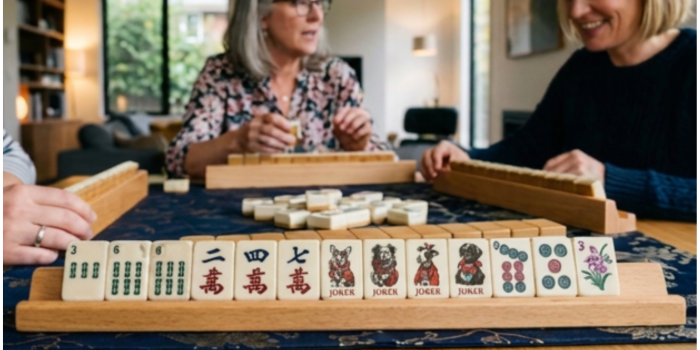
If you’re learning how to play American mahjong, the joker tile usually catches your attention quickly.
Unlike most tiles in the game, jokers are wild cards. They can stand in for other tiles in many combinations, which makes them incredibly powerful — and occasionally a little misunderstood.
Once you understand how jokers work, they become one of the most interesting strategic elements in the game.
What Jokers Do in American Mahjong
In American mahjong, jokers act as wild tiles.
That means they can substitute for another tile in many of the combinations listed on the annual mahjong card. If a hand requires three, four identical tiles, or five — a pung, a kong or a quint — a joker can often stand in for one of those tiles.
For example, if a hand requires three green dragons and you have two green dragons and a joker, the joker can complete that combination.
This flexibility makes jokers extremely valuable.
But they aren’t unlimited.
When Jokers Can’t Be Used
One of the most important rules beginners learn is that jokers can’t be used everywhere.
In most standard American mahjong rules:
• Jokers cannot be used in pairs
• Jokers cannot be used for single tiles or runs
• Jokers are generally used only in pungs, kongs, or quints
The annual card ultimately determines where jokers are allowed, so players always check the specific hand they are building.
Understanding these limits helps prevent one of the most common beginner mistakes: assuming a joker can fill any gap.
The Joker Exchange
Another unique feature of American mahjong is the joker exchange.
If a player has exposed a joker as part of a pung, kong, or quint, another player who holds the real (also called the “natural”) tile can often exchange it for the joker.
For example, imagine a player has exposed a pung of five-bam tiles using two real bamboo tiles and a joker. If another player later has, or draws, a five-bam, they may exchange that tile for the joker and add that joker to their hand.
The combination stays intact, but the joker changes hands.
Here are five things to know about a joker exchange:
A joker exchange may happen only on your turn
You must draw or call a tile before making the exchange
You may exchange a tile from your own exposed hand
You may exchange more than one joker on your turn
You can discard a joker (it happens) but you can never call a joker
Why Jokers Change the Game
Because jokers are so flexible, they can dramatically affect how a hand develops.
Drawing a joker early can open up new possibilities for a hand. It can make certain combinations achievable that might otherwise take much longer to complete.
At the same time, experienced players often think carefully about when to expose jokers and when to hold them.
A joker on the table becomes visible to everyone.
And visible tiles change how other players read the game.
A Tile With Personality
Jokers are also one of the reasons American mahjong feels a little different from other versions of the game. They introduce an element of surprise and adaptability. A hand that looks unlikely one moment can suddenly become possible with the right draw.
Pull Up a Chair
If you play long enough, you’ll learn that jokers are both powerful and unpredictable.
They can rescue a struggling hand or help complete a winning one.
But like many things in mahjong, the real fun isn’t just the tile itself.
It’s the moment when it appears.
If You're Learning Mahjong
If you’re new to American mahjong, our beginner guides explain the tiles, the rules of the game, and how hands are built step by step.