
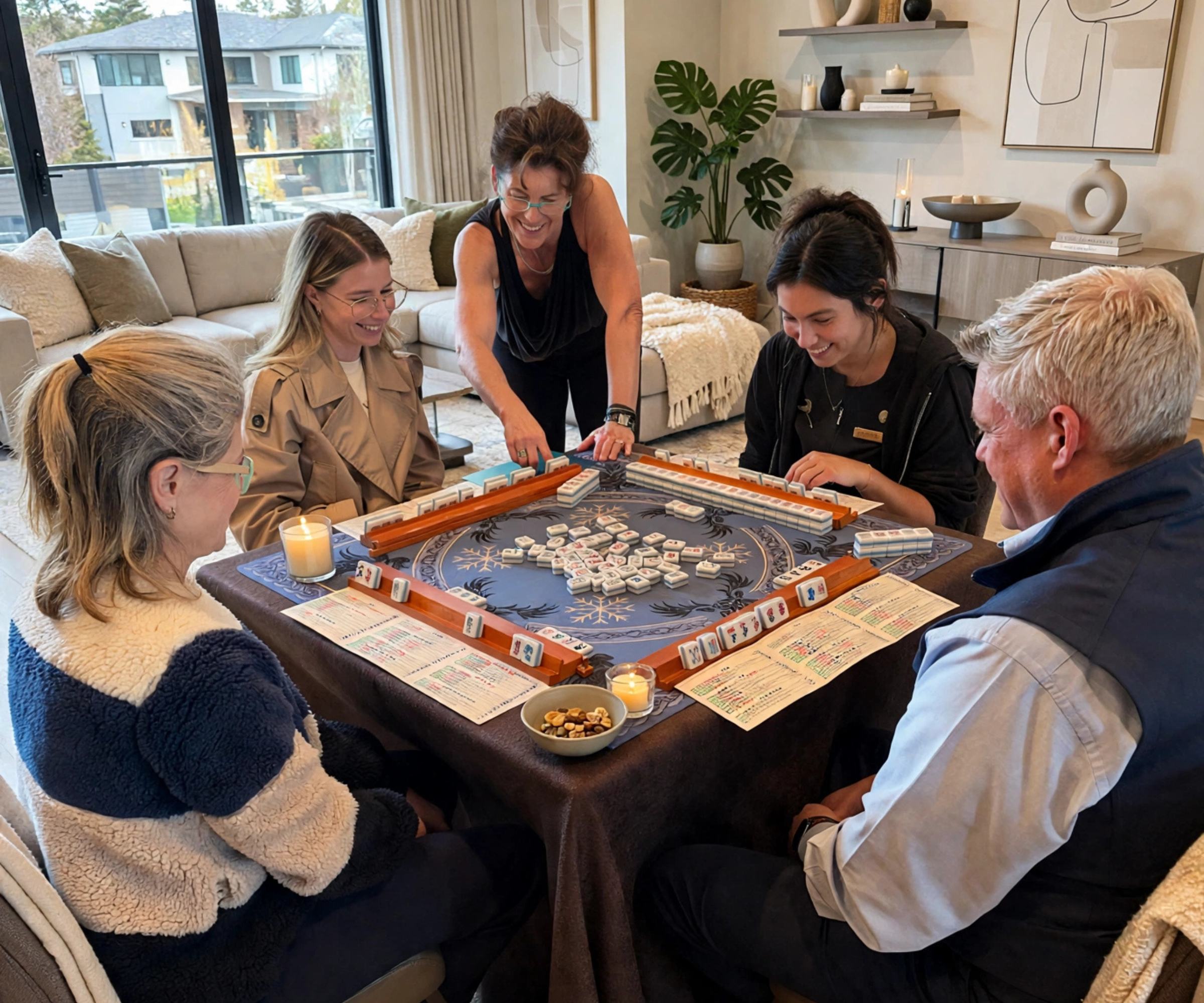
I've been playing American mahjong for years, teaching it, and even building a business around it. So you'd think I'd know just about every variation of the game by now.
Apparently not.
Last week, while we were in San Diego for the USA Pickleball National Championships, we sat down to play mahjong with someone who introduced us to something I'd never heard of: the mush.
The mush? What on earth is a mush?
Turns out, it's a variation on the Charleston that some mahjong groups have been playing for years. And while it's not an official National Mah Jongg League rule, it's an interesting little twist that we found really fun. And, I want to be sure you don’t get caught off guard like we were. So here’s your mush primer.
First, a Quick Charleston Refresher
If you play American mahjong, you know the Charleston. It's the series of tile exchanges at the beginning of every game that gives players a chance to improve their starting hands and, sometimes, gain a bit of insight into what other players might be going for.
The first Charleston involves passing three tiles right, across and left. If everyone agrees, there's a second Charleston in the opposite direction. At the end, players sitting across from one another have the option of exchanging up to three tiles in a courtesy pass.
And then the game begins.
Unless, of course, your table decides to add a mush.
So, What Exactly Is a Mush?
Think of it as a little extra opportunity to get rid of tiles you don't want and, hopefully, pick up something more useful.
Because it is a “house rule” and not an official rule, there are variations, but here’s how it typically works:
After the Charleston and courtesy pass are complete, each player decides whether to participate.
Participating players place up to three (though some people allow five) unwanted tiles face down in the middle of the table.
In some variations, four additional tiles from the wall are added to the mush.
The tiles are mixed together so nobody knows which tile came from whom.
Each player draws back exactly as many tiles as they contributed.
That's it. A little extra mixing, a little extra luck, and perhaps a better starting hand.
For example, let's say you have two tiles that don't seem to fit any of the hands you're considering. You put those two tiles into the mush, the tiles get mixed together, and you draw two back.
Maybe you get exactly what you need. Maybe you get two equally useless tiles. That's mahjong.
There are variations, of course. Some groups allow more than three tiles, and others do the mush at a different point in the Charleston. That's why it's important to agree on the rules before you begin.
Why Would You Want to Mush?
The appeal is pretty simple. Sometimes you finish the Charleston and still have a few tiles that don't seem to belong anywhere. The mush gives you one more opportunity to improve your rack before the first discard.
Unlike the regular Charleston, where tiles are passed in a particular direction, the mush introduces a random exchange among the participating players.
There's no guarantee that the tiles you pick up will be any better than the ones you put in. But if you're holding a couple of tiles that are doing absolutely nothing for you, why not take a chance?
Of course, there's also a case for leaving well enough alone. If you've finished the Charleston with a terrific rack, you may have no interest in adding another exchange.
And that's perfectly fine.
House Rules Are House Rules
Here's the important distinction: the mush is not part of the official National Mah Jongg League rules.
It's a house rule, meaning it's something a group of players chooses to add to the game. And because different groups play it differently, you shouldn't assume everyone knows what you mean when you suggest a mush.
Before you play, agree on when it happens, how many tiles each person can contribute, whether participation is optional and how the tiles will be redistributed. And if you're playing in a tournament or organized event, follow that event's rules rather than introducing your own.
I love discovering these little variations and traditions. Even after years of playing, there's apparently still plenty for me to learn.
So the next time you're sitting down with your regular mahjong group, you might ask, "Have you ever tried a mush?"
At the very least, you'll have an interesting conversation.
And who knows? You might pick up exactly the tile you've been hoping for.