
Mahjong Is Not a Hobby. It’s a Ritual.
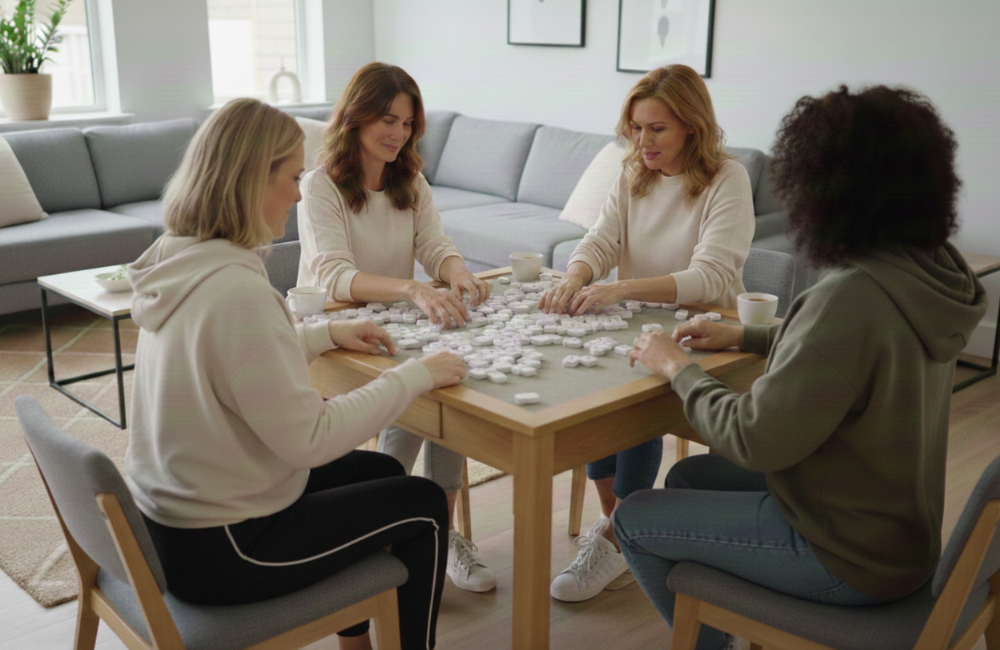
Mahjong is more than a game. For many players, a weekly mahjong night becomes a standing tradition that anchors friendship, conversation, and community. What begins as learning the tiles and the rules often turns into something much deeper. Over time, mahjong stops feeling like a hobby and starts feeling like a ritual.
People often describe mahjong as a hobby.
That’s technically correct, in the same way that calling dinner with friends “calorie consumption” is technically correct.
Yes, mahjong is a game. There are tiles and rules and strategies and the occasional moment of triumph when the exact tile you need appears in the wall like a small miracle.
But if you spend any time around people who play regularly, you start to notice something.
Mahjong is not really a hobby.
It’s a ritual.
Why Weekly Mahjong Becomes a Standing Tradition
Most hobbies are solitary. You read. You garden. You go to the gym.
Mahjong is different. Mahjong requires a table. Four people. A shared set of tiles. A little bit of time.
And once you’ve played a few times, something subtle happens.
The game begins to anchor a rhythm in your life.
Maybe it’s Tuesday mornings. Maybe Thursday nights. Maybe the second Sunday of the month. It doesn’t matter which day it is, only that eventually the question shifts from Should we play mahjong this week? to What time are we playing?
When that happens, the game stops being an activity.
It becomes a standing date.
What Happens Around the Mahjong Table
Mahjong is one of the rare games where conversation and competition can exist comfortably in the same space.
There are moments of intense focus when everyone studies the discards and counts tiles. Then the tension breaks and someone tells a story. Someone laughs. Someone groans when a joker gets played in exactly the wrong place.
The rhythm of the game creates natural pauses, little openings where people reconnect.
Phones tend to disappear. The table becomes the center of the room.
You show up with whatever kind of day you’ve had, and by the time the tiles are pushed in and the racks are rebuilt for the next hand, the mood has shifted.
Something about the shared focus of the game makes it easier to be present with each other.
Mahjong Creates a Shared Language
The longer a group plays together, the more the table develops its own culture.
There are inside jokes.
There are predictable reactions when someone calls a tile.
There are players who take big risks and players who build slow, steady hands.
The language of the game becomes shorthand.
“Charleston.”
“Dead.”
“Mahjong.”
A single word can change the entire mood of the table.
It’s the kind of shared language that forms in communities that gather regularly. A little ecosystem develops around the game.
And that ecosystem becomes part of the ritual too.
Why Mahjong Night Actually Happens (When Other Plans Don’t)
One of the quiet benefits of mahjong is that it creates structure in a way that feels effortless.
Adults are notoriously bad at maintaining regular social time. Everyone is busy. Calendars are full. Weeks slide past.
But a recurring game has gravity.
If four people have agreed to meet, the odds are much higher that everyone shows up. It’s harder to cancel when three other players are counting on you.
And because the game has a clear beginning and end, it fits into real life. You play for a few hours. You reset the racks. You say goodnight.
No elaborate planning required.
Just the table.
Why Mahjong Starts to Feel a Little Sacred
If you play long enough, something else happens.
You begin to realize that the game itself is only part of the draw.
Yes, the strategy gets more interesting. Yes, the thrill of calling mahjong never really gets old.
But the real magic is the gathering.
Four chairs.
Tiles clicking against the table.
The quiet focus of a shared game.
In a world that constantly pulls our attention in a hundred directions, the mahjong table creates a small pocket of time where everyone is fully present.
And when something like that repeats week after week, it begins to feel a little bit sacred.
Not formal. Not serious.
Just meaningful.
Pull Up a Chair
At Blue Moon Mahjong, we love the strategy of the game. We love the puzzle of the card and the moment when a hand suddenly comes together.
But the real reason people fall in love with mahjong is what happens around the table.
The laughter.
The rhythm.
The ritual of showing up.
Because once a group begins to gather regularly, the tiles become something more than a game.
They become a reason to pull up a chair.