
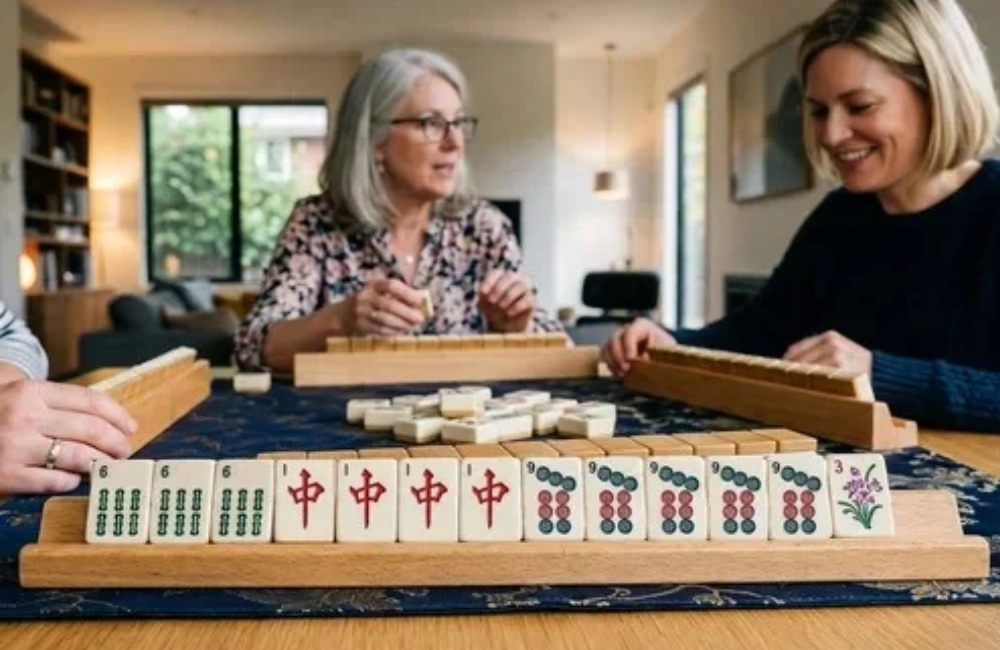
When you first start learning American mahjong, it can feel like you're learning a whole new language. Charleston. Exposure. Wall. The dreaded Dead Hand. And then there are the pungs, kongs and quints.
If you've ever wondered what the difference is between a pung and a kong, or why a quint sounds like something you might have studied in Latin class, you're not alone.
The good news? This is one of the easiest parts of mahjong to learn. And once you understand it, you'll never have to think too hard about it again.
It All Comes Down to How Many
A pung, kong, quint or sext is simply a group of identical tiles. The name tells you how many tiles are in the group. That's it.
Pung = 3 identical tiles
Three 5 Bams? That's a pung. Three Red Dragons? Also a pung. Think of a pung as a trio.
Kong = 4 identical tiles
Four 8 Dots? That's a kong. Four North Winds? Also a kong.
Here's our favorite memory trick: King Kong is bigger than a pung. So if you remember that King Kong is big, you'll remember that a kong has four tiles instead of three.
Quint = 5 identical tiles
Now we're getting ambitious. A quint is a group of five identical tiles. Since a standard American mahjong set has only four of each numbered tile, wind or dragon, you'll need at least one joker to make a quint.
Sext = 6 identical tiles
And here's a new addition to the conversation! The 2026 National Mah Jongg League card includes a sext, a group of six identical tiles.
Like a quint, a sext requires jokers because there are only four natural copies of any given numbered tile, wind or dragon. You'll need at least two jokers to complete a sext.
What About Pairs and Singles?
While we're learning the language, let's not forget the smaller groups.
A single is one tile, and a pair is two identical tiles. Unlike pungs, kongs, quints and sexts, singles and pairs cannot contain jokers.
That's an important distinction, especially when you're working toward a hand with multiple pairs. You may have a rack full of jokers, but they won't help you complete a pair.
A Little Mahjong Math
Here's another useful thing to understand: the standard American mahjong hand contains 14 tiles. Every hand on the card adds up to 14, whether it's made up of singles, pairs, pungs, kongs, quints or, now, a sext.
For example, a hand might contain two pungs and two kongs (3 + 3 + 4 + 4 = 14). Another might contain two pairs and two quints (2 + 2 + 5 + 5 = 14).
Learning to recognize these groupings makes the card much easier to read. Instead of seeing a long string of numbers and colors, you'll start to recognize the structure of the hand.
And that's a big step toward becoming a more confident player.
One Last Thing to Remember
You don't have to memorize every hand on the card, but knowing these basic building blocks will make playing much easier.
Three is a pung. Four is a kong. Five is a quint. Six is a sext.
And if you get stuck, remember King Kong. He's bigger than a pung.
Sometimes the simplest memory tricks are the ones that stick.