
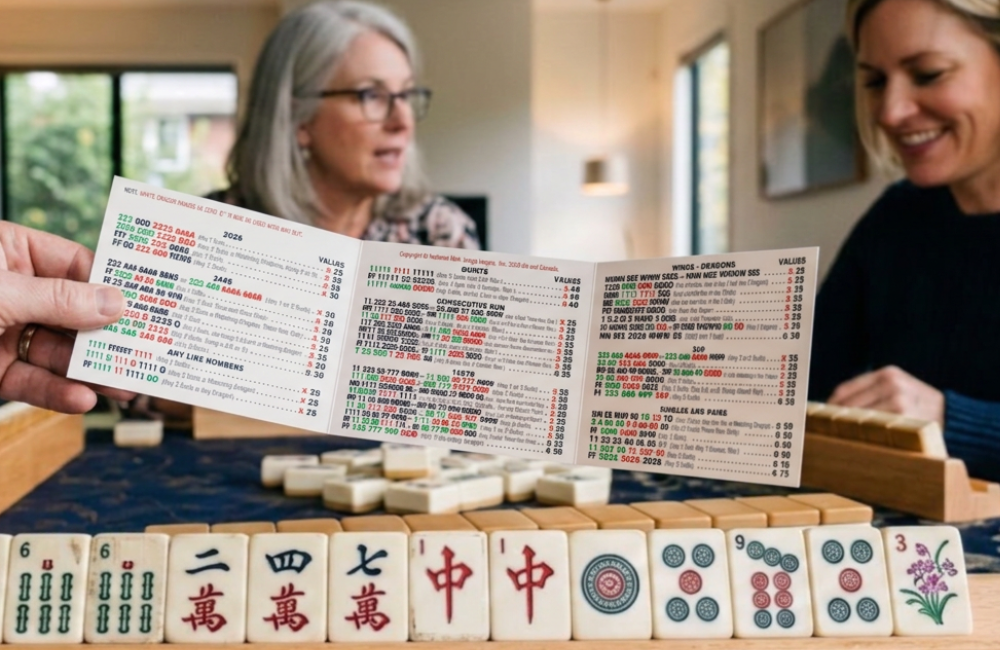
When I took my first mahjong lesson, before I had even ordered my first official National Mah Jongg League card, I asked the instructor if I could borrow one of hers and take it home to study.
“I want to learn all of the hands,” I told her.
“Sure,” she said. “But you won’t actually look at it until our next lesson.” She said it knowingly, like she had seen my type before.
I was confident she was wrong. I was excited to master this game. I was going to take that card home, study it, begin memorizing the hands and show up at my next lesson ready to go.
She was right.
I didn’t pull it out again until our next lesson. And years and many, many games later, I still haven’t “memorized” the entire card.
Here’s the good news: you don’t have to either.
The Card Isn’t a Test
When you first look at the mahjong card, it can feel like a lot. Numbers, colors, different sections, strange combinations and dozens of possible hands crammed onto one little card. It’s tempting to think that becoming a good player means somehow getting all of that information into your head.
It doesn’t.
The card is a tool. You’re supposed to use it while you play. And rather than trying to absorb the whole thing at once, one of the best things you can learn to do is make the card smaller.
At Blue Moon, we teach new players to begin with the tiles in front of them. What do you have a lot of? Do you see a cluster of consecutive numbers? Several even numbers? Multiple pairs? Winds or dragons that might work together? Your tiles give you clues about where to look on the card. Instead of considering every possible hand, you can begin eliminating entire sections and focusing on the ones that make sense for the rack you actually have.
The Rule of 7
We also teach something we call the Rule of 7. When you’re considering a hand, count how many tiles in your rack are already working toward it. If you have seven or more, that hand deserves serious consideration. If you have four and are mentally turning three other tiles into the ones you wish you had, keep looking.
This sounds simple, but it helps solve one of the biggest problems new players face: falling in love with a hand on the card instead of paying attention to the hand their tiles are actually giving them. Despite my years of playing, I did this just last week. I don’t know why, but one hand kept calling to me. I lost three times in a row. Why? Because I was determined to beat that hand. My tiles had a different plan.
The goal isn’t to find the most interesting hand on the card. It’s to find the best hand for the tiles in front of you.
Familiarity Comes From Playing
Something funny does happen the more you play: you start to know the card. Not because you sat down and memorized it, but because you’ve seen the patterns again and again. You begin to know which sections to check when you have certain tiles. You recognize familiar hands. You start seeing possibilities more quickly and noticing when one potential hand can pivot into another.
By late in the season, you may surprise yourself with how much of the card you know without looking. Then the new card arrives in the spring and humbles all of us again.
So if you’re learning to play, resist the urge I had at my very first lesson. Don’t take the card home and study it like you’re preparing for the SATs.
Keep it in front of you. Learn how to read it. Learn how to narrow it. And then play.
Turns out my first mahjong teacher knew exactly what she was talking about.